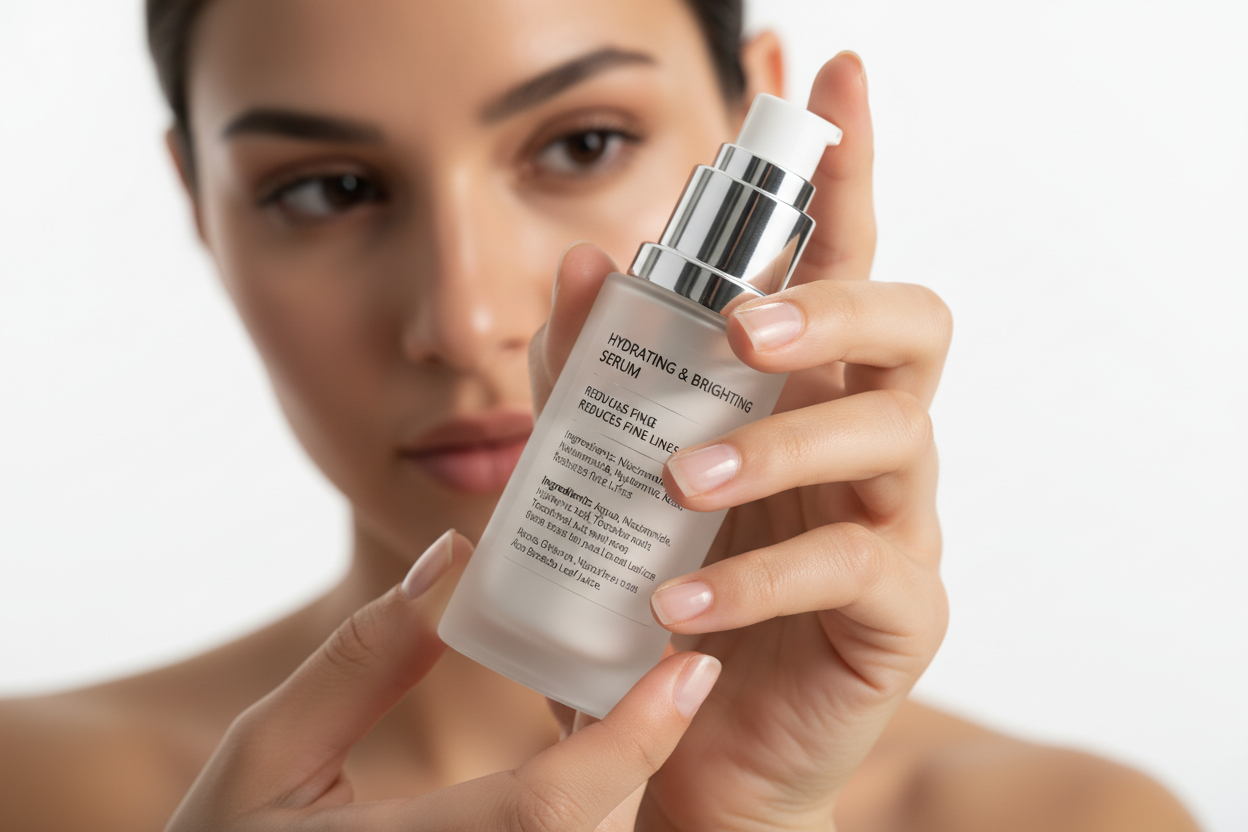

Cosmetic products sold in New Zealand and Australia must carry an ingredient list in descending order of concentration, the product identity, net content, a batch code, and a local supplier name and address. New Zealand's rules sit under the EPA's Cosmetic Products Group Standard; Australia's under the ACCC's Consumer Goods (Cosmetics) Information Standard 2020.
Most founders discover this after the labels have been printed. Artwork is usually the last thing signed off and the first thing to cause a recall. This guide covers what must physically appear on the label — what you are allowed to claim on it is a separate body of law.
What must legally appear on a cosmetic label in New Zealand?
New Zealand regulates cosmetics as chemicals, not consumer goods. The Cosmetic Products Group Standard 2020 — issued under the Hazardous Substances and New Organisms (HSNO) Act and administered by the Environmental Protection Authority — sets the labelling obligations in Schedule 1. A compliant label carries:
- A full ingredient list, using International Nomenclature of Cosmetic Ingredients (INCI) names, in descending order of concentration.
- Nanomaterials flagged explicitly — any ingredient present as a nanomaterial must be followed by "(nano)" in the list.
- The name and New Zealand address of the importer or manufacturer — an overseas head office does not satisfy this.
- Net content and a batch identifier that traces back to a specific production run.
- Any warnings or conditions of use required for restricted ingredients under Schedules 4 to 8.
That last point catches people. Some ingredients are permitted only up to a set concentration, and only if a specific warning appears on the pack. The wording is not yours to choose.
What are Australia's cosmetic labelling requirements?
Australia splits the job across two regulators, which is where the confusion starts.
Ingredients are governed by the Consumer Goods (Cosmetics) Information Standard 2020, enforced by the ACCC. The list must appear on the container — or on the product itself if there is no container. Where the size, shape or nature of the pack genuinely prevents this, the information must be prominently displayed alongside the product at point of sale.
Two ordering methods are acceptable:
- All ingredients in descending order by mass or volume; or
- Ingredients at 1% or more in descending order, then ingredients under 1% in any order, then colour additives in any order.
Percentages are not required, with one exception: hand sanitiser with alcohol as the primary active must state alcohol content as % v/v, plus mandatory warnings.
Everything else on the label — net content, country of origin, supplier identification, and the accuracy of any marketing statement — sits under the Australian Consumer Law, not the Information Standard. Separately, AICIS governs whether your ingredients may legally be introduced into Australia at all. That is an obligation on the importer or manufacturer, not a label element.
Some products sit outside the Information Standard entirely: therapeutic goods, cosmetics made in Australia solely for export, free samples and testers. Sunscreens are regulated by the TGA under a different regime.
Do I have to use INCI names?
In New Zealand, yes — INCI naming is the expectation under the Group Standard. In Australia, the standard permits INCI names or the accepted English name.
Use INCI in both markets regardless. One artwork file then works either side of the Tasman, it is what allergy-aware customers read, and it is what any future EU or UK distributor will require.
What changed in New Zealand on 1 January 2026?
The Cosmetic Products Group Standard (Amendment) Notice 2024 came into force on 1 January 2026 — the most significant update to New Zealand cosmetic rules in years:
- Scope widened to include non-hazardous cosmetics that contain a hazardous substance.
- Schedules 4 to 8 — prohibited, restricted and permitted ingredients — updated to align more closely with European rules.
- PFAS added to the prohibited schedule and being phased out of cosmetics in Aotearoa.
Importers and manufacturers have had to meet the updated standard since 1 January 2026, with sell-through of non-compliant stock permitted until 1 January 2027 and disposal expected by 1 July 2027. If your formula was signed off before 2024 and has not been reviewed since, check it against the amended schedules now — while you have runway rather than a deadline.
What happens if my label is wrong?
In Australia, failing to meet a mandatory information standard can attract fines and penalties, and suppliers may be required to recall the product. In New Zealand, non-compliance with a group standard is an offence under the HSNO Act. Either way the practical consequence is stock you cannot sell — and the real cost is rarely the fine. It is 2,000 units in a warehouse with unusable artwork, plus reprints, plus a relabelling job someone does by hand.
How do I get the label right before printing?
Check artwork against the regulations when the formula is finalised, not when the packaging quote arrives. Three things happen together: the formula is locked, the ingredient list is generated from the actual manufacturing formula rather than the brief, and restricted-ingredient warnings are drafted.
At The INCI Lab, ingredient list generation and market-specific labelling guidance for New Zealand, Australia, the EU and the US are built into both formulation pathways — The Accelerator (4–6 months, starting from $2,000) and The Visionary (9–12 months, starting from $4,000, with full IP transfer). Minimum order quantities run from 100 to 500 units, so you are not committing to a five-figure print run to find out whether your artwork works.
Already have a product on shelf and want a second pair of eyes? Ask The Chemist is a 30-minute consult at $150 — usually cheaper than one reprint.
Frequently asked questions
Does a New Zealand label work in Australia?
Usually, with modification. Both markets accept INCI lists in descending order, so the ingredient panel often transfers. Supplier identification does not: Australia expects an Australian contact, New Zealand a New Zealand importer or manufacturer address. Many brands run a dual-address label.
Do I need to list ingredients on something as small as a lip balm?
The requirement does not disappear. In Australia, where the size or shape of the container genuinely prevents ingredient labelling, the information must be prominently displayed alongside the product at point of sale. That works in retail and is awkward online, so the practical answer for small packs is a peel-back or booklet label.
Is AICIS registration something I put on my label?
No. AICIS is a registration obligation for whoever introduces the chemicals into Australia, typically the importer or manufacturer. It is a business registration, not a product certification, and should not appear as a claim or logo on your pack.
Does preservative testing change what goes on the label?
Preservatives are declared like any other ingredient, by INCI name in concentration order. Preservative efficacy testing does not change the label itself, but it is what substantiates your shelf life and period-after-opening. At The INCI Lab, preservative efficacy testing is NZ$1,200 per formula.
Can I print "natural", "clean" or "chemical-free" on my label?
Those are marketing claims, not labelling elements, and are regulated separately under fair trading and consumer law in both countries. "Chemical-free" in particular is difficult to defend on any cosmetic product. Settle claims substantiation before you commit anything to artwork.
General information for New Zealand and Australian brand owners; not legal advice. Regulations change — check the current instruments for your product.
Working out what your product needs? Compare our formulation pathways or talk to our team in Auckland.