
To start a skincare brand in New Zealand or Australia, you need a clear first product, a stability-tested formula you have the right to sell, a compliant label, a manufacturer that runs small batches, and a launch plan. On a semi-custom route a first product typically takes 3 to 4 months; a fully custom formula takes 6 to 12 months.
This guide walks through each step in the order it happens in a formulation lab, with the real numbers we use at The INCI Lab in Auckland. It is written for founders in NZ and Australia, so the regulatory notes cover the EPA, AICIS, the ACCC and the TGA rather than US rules. If you would rather read it offline, our free guide to building your own beauty brand covers the same journey in more depth.
What do you need to decide before you talk to a cosmetic chemist?
You do not need a formula, a logo or a company structure to start. You do need answers to five questions, because they decide which route, which tests and which packaging make sense:
- Who is it for? Skin type, age range, the problem they want solved and where they shop.
- What is the first product? One hero product (a serum, a cleanser, a body butter) is easier to get right than a full range.
- What should it feel and smell like? A reference product you love for its texture is more useful than a list of trending ingredients.
- What will you claim? "Hydrating" and "soothing" are cosmetic claims. "Treats eczema" or "heals acne" are therapeutic claims and change how the product is regulated.
- Where will you sell it? NZ only, NZ and Australia, or further afield. Each market adds labelling and registration steps.
From the lab: the briefs that save the most time are one page long and include a "must not contain" list (for example no essential oils, no silicones, fragrance-free). That single list often removes a whole sampling cycle, because it rules out formula bases before we make them.
If you are wondering what a cosmetic chemist does day to day, see our guide.
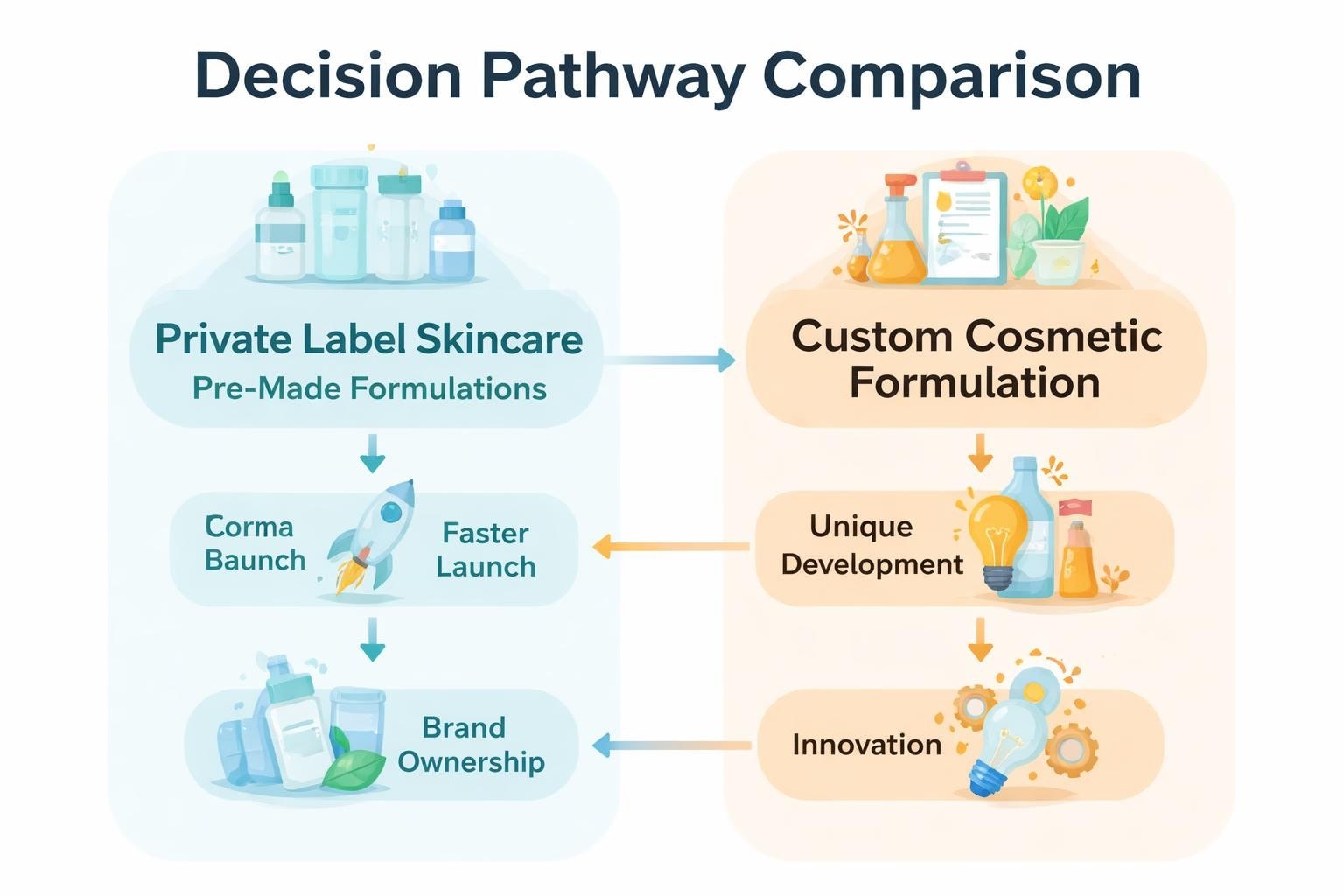
Which route suits you: private label, semi-custom or fully custom?
There are three common ways to get a formula, and each suits a different stage. None is the "right" answer; it depends on budget, timeline and how important formula ownership is to your brand.
| Route | What you get | Formula ownership | Best for |
|---|---|---|---|
| Private label (ready-to-go) | An existing, stability-tested stock formula under your brand | The formula stays with the lab | Testing the market quickly with the lowest development spend |
| Semi-custom (The Accelerator) | A stability-verified base customised with your actives and fragrance; up to 2 sampling cycles; a 12-week accelerated stability programme; typically 3 to 4 months | You own the finished SKU profile; the base is licensed to you | Founders who want a product that feels like theirs without starting from a blank page |
| Fully custom (The Visionary) | A clean-sheet formula built to your performance target; 3 sampling cycles; typically 6 to 12 months | Full IP transfer to you | Brands whose formula is their point of difference, or who plan to scale with other manufacturers |
If you already have a formula, a contract manufacturer can make it for you, and a formulation studio can review it first so it scales cleanly from kitchen batch to production. Our comparison of private label, white label and custom formulation in NZ and Australia goes deeper, and if ownership matters to you, read why indie skincare brands should own their formulation IP.
Not sure yet? The Accelerator Discovery Kit (NZ$89) lets you try up to 2 stability-tested stock formulas before you commit. It is dispatched within 1 to 2 working days, ships worldwide, and your $89 is credited toward your Accelerator project.
How does formulation and sampling actually work?
Whichever route you choose, development follows the same loop:
- Brief. We agree the product, claims, target texture, markets and packaging type.
- Samples. The lab makes small batches for you to use at home. The Accelerator includes up to 2 sampling cycles (extra cycles NZ$150 each); The Visionary includes 3.
- Feedback and refinement. You tell us what to change: thicker, lighter, less scent, faster absorbing.
- Lock the formula. Once you approve a sample, the formula is fixed before testing starts, because any later change means testing again.
From the lab: a common surprise is that a "small" change after sampling is not small. Adding a botanical extract or raising the fragrance level in a sample you already loved can thin a gel, shift the colour or change how the preservative performs. That is why we finalise every ingredient before stability testing, rather than tweaking afterwards.
For a fuller walk-through of each stage, see our overview of skincare product development.
Ready to map out your first product? Begin a project with The INCI Lab and tell us about your idea; we will recommend a route and timeline before you spend anything on development.
What testing does a new skincare product need before launch?
Testing is what turns a nice sample into a product you can sell with confidence. These are the core checks for a new formula:
- Accelerated stability testing. The product is stored at raised temperatures to show how it will age. At The INCI Lab it costs NZ$600 per formula and includes packaging compatibility in your actual pack. It runs as a 12-week accelerated programme on every pathway, including The Accelerator.
- Preservative efficacy testing (PET, or challenge testing). Proves the preservative system protects the product once it is opened and used. It is arranged per formula and quoted on request.
- Batch QA. Every production batch gets micro testing and a certificate of analysis (COA). Raw-material COAs and safety data sheets are supplied too.
Shelf life is then assigned per product from the stability and PET results, and is typically 3 years (lower for some categories, such as intimate care). Our guide to cosmetic shelf life, PAO and expiry dates in NZ and Australia explains how that number reaches your label.
From the lab: test in the pack you will actually sell in, not a lab jar. Oil-rich formulas can haze some frosted plastics or lose fragrance through the wall of the bottle, and a jar exposes a formula to fingers and air in a way an airless pump does not. Those differences show up in compatibility testing, and it is far cheaper to find them before you order thousands of components.
What are the rules for selling skincare in New Zealand and Australia?
New Zealand. Cosmetics are regulated by the Environmental Protection Authority (EPA) under the Cosmetic Products Group Standard, which sets ingredient restrictions and labelling requirements. The EPA updated the cosmetics rules from 1 January 2026, so check any formula and label against the current version. Claims are covered by the Fair Trading Act: the Commerce Commission expects you to have reasonable grounds for a claim at the time you make it.
Australia. Any business that imports or manufactures cosmetics in Australia must register with AICIS (the Australian Industrial Chemicals Introduction Scheme) before it starts, with no minimum quantity. Ingredient labelling follows the mandatory cosmetics ingredient labelling standard enforced by the ACCC, and claims fall under the Australian Consumer Law. Products that make therapeutic claims, and most primary sunscreens, are regulated by the TGA as therapeutic goods rather than as cosmetics.
In practice, the claims question is where founders most often get caught out. Words like "heals", "cures" or "treats" can move a product out of cosmetics altogether, so we check your claims against the brief from day one. For the detail, see cosmetic labelling requirements in NZ and Australia and cosmetic compliance for Australian brands. We also provide formulation and regulatory guidance for the EU, UK and US if you plan to export.
How much does it cost to start a skincare brand?
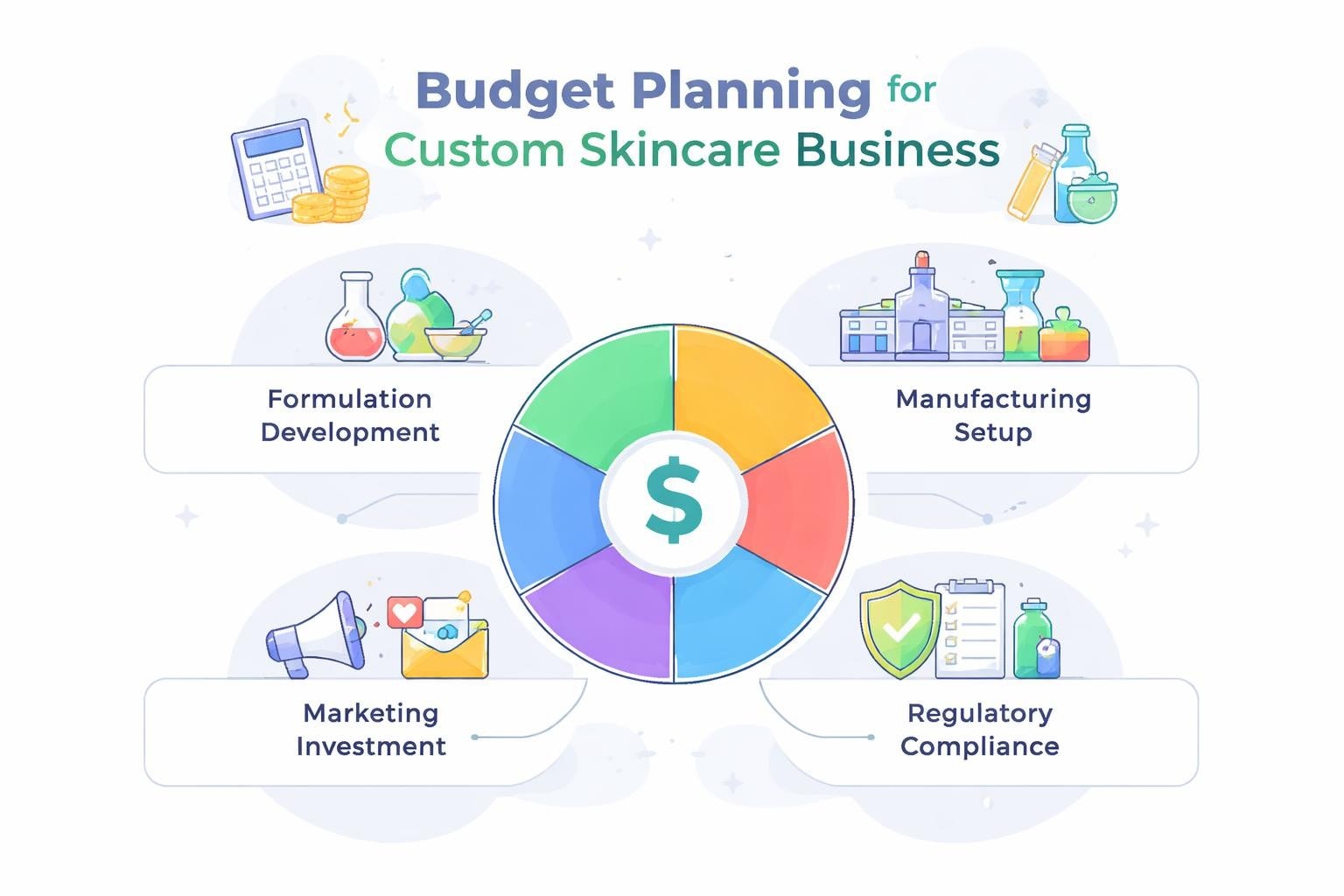
The honest answer is that it depends on the route, the number of products and your packaging. What we can give you are the building blocks, so you can plan a budget:
- Trying stock formulas: Discovery Kit NZ$89.
- Expert advice before you commit: a 30-minute Ask The Chemist video consult is NZ$150.
- Development: quoted after your brief, depending on route. Development is paid in milestones, and Klarna is available for each milestone.
- Testing: stability NZ$600 per formula; preservative efficacy (challenge) testing is arranged per formula and quoted on request.
- Packaging: normally supplied by you. If we source it, it is charged at cost plus 5% handling plus shipping. Retail cartons are supplied by you; shipper cartons by us.
- Manufacturing: minimum 100 units per product, paid 50% on order and 50% before dispatch, invoiced on actual filled units (3% over/under tolerance), with no annual or setup charge.
Many successful brands launch with a small core range (often one to three products) rather than a full line. It keeps stock and testing costs down, and your first customers tell you what to make next. Our breakdown of the cost to start a custom skincare line goes into more detail.
How does your first production run work?
Once the formula has passed testing and your packaging and labels are ready, production is the quick part. Our minimum order is 100 units per product, which suits a first launch, a market test or a stockist trial. Production takes 3 to 4 weeks, counted from when your packaging and the raw materials arrive, and repeat orders take 3 to 4 weeks too. Every batch is micro tested and comes with a COA. Read more about low MOQ cosmetic manufacturing in NZ and Australia.
From the lab: packaging, not formulation, is the most common reason a launch date slips. Order components as soon as the pack is confirmed in compatibility testing, and allow for decoration and freight before the 3 to 4 week production window can start.
Alongside production, put the business basics in place: product liability insurance (many stockists ask for it), a simple system that records batch numbers and expiry dates against each order, and a plan for reordering before you run out.
What should you do before launch day?
- Brand and packaging design that fits the label space your compliance information needs.
- A website and email list started well before launch, with honest content about how the product was developed.
- Claims you can back up on every page, post and label, using the same wording you agreed with your chemist.
- A reorder plan based on your 3 to 4 week production lead time.
Our free Build Your Own Beauty Brand guide includes checklists for each of these steps.
Frequently asked questions
How can I start my own skincare brand in New Zealand?
Start with one product and a clear customer, then choose a route: private label, semi-custom or fully custom. A formulation studio handles the formula, testing and small-batch manufacturing (from 100 units per product), and checks your label and claims against the EPA's cosmetics rules and the Fair Trading Act.
What do you need to start a skincare brand?
A product idea and target customer, a formula you have the right to sell, stability and preservative efficacy test results, compliant labels, packaging, a manufacturer and a way to sell. You do not need your own lab or equipment.
Can I start a skincare brand with little money?
Yes, if you keep the first launch small. Trying stock formulas through the NZ$89 Discovery Kit, launching one hero product, supplying your own packaging and ordering the 100-unit minimum keeps the first spend low. Development milestones can be paid with Klarna.
How do I start a skincare brand in Australia?
The steps are the same, plus Australian rules: register with AICIS before importing or manufacturing cosmetics, follow the ACCC's mandatory ingredient labelling standard, and keep claims cosmetic so the product is not treated as a therapeutic good by the TGA. NZ-made products can be sold in Australia once these are in place.
How long does it take to create a skincare line from scratch?
On a semi-custom route like The Accelerator, typically 3 to 4 months. A fully custom formula through The Visionary typically takes 6 to 12 months. Production then takes 3 to 4 weeks from when packaging and raw materials arrive.
Do I own the formula if I start a skincare brand with a lab?
It depends on the route. With private label, the formula stays with the lab. With a fully custom Visionary formula, the IP transfers to you in full. Ask any lab to put ownership in writing before development starts.
Start your skincare brand with a cosmetic chemist
The INCI Lab is an award-winning formulation studio in Auckland. Awards: Pure Beauty Global Gold 2023 | C&T Allē Awards 2025 & 2026 | Clean + Conscious Awards 2023 & 2026 (Gold + Editor's Choice). We formulate, test and manufacture in small batches for founders across New Zealand and Australia. Begin a project to talk through your first product, or book Ask The Chemist if you would like a 30-minute chat first.
Reviewed by Merve Samur, cosmetic chemist, founder of The INCI Lab and President of the NZSCC.